Sundar Pichai Warns AI Investment Boom Has 'Elements of Irrationality' — No Company Is Immune
- Maverick Throttleworth
- 28 November 2025
- 0 Comments
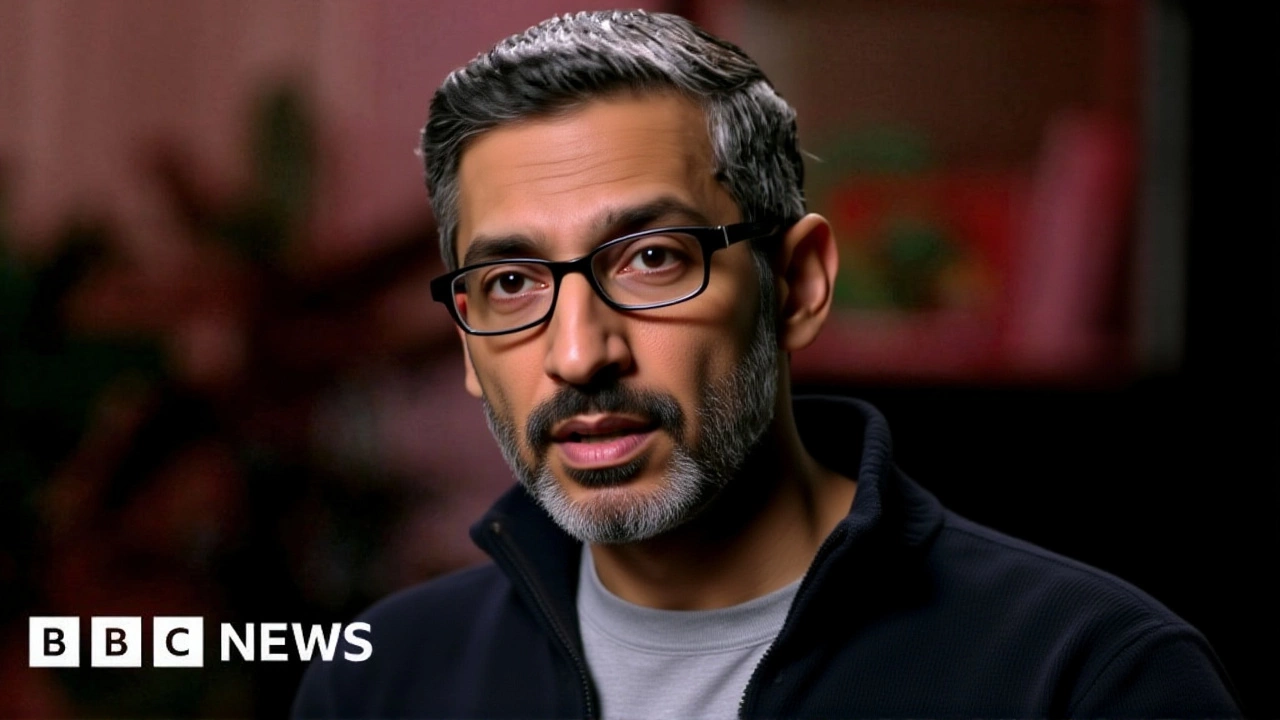
When Sundar Pichai, CEO of Alphabet Inc., told BBC News that the trillion-dollar rush into artificial intelligence carries "elements of irrationality," he didn’t just sound like a cautious executive — he sounded like someone who’s seen this movie before. The interview, published on November 18, 2025 on Google’s headquarters in Mountain View, California, wasn’t just another tech talking point. It was a sobering reality check from one of the most powerful figures in global technology. And the message? Even Google isn’t safe if the AI bubble bursts.
The Dot-Com Echo
Pichai didn’t mince words. He compared today’s AI frenzy to the late 1990s dot-com boom — a time when companies with no revenue and questionable business models were valued in the billions because they had ".com" in their name. "There was clearly a lot of excess investment," he said, "but none of us would question whether the internet was profound." That’s the key nuance. He’s not dismissing AI. He’s saying the *valuation* might be detached from reality — even as the underlying tech is revolutionary. The parallels are chillingly familiar. In 1999, venture capital poured into internet startups like water on a fire. Then came 2000. And then came the crash. Billions vanished overnight. Companies like Pets.com and Webvan evaporated. But the internet? It didn’t die. It just got real. And now, Pichai is warning that AI is at that same inflection point.Why Google Thinks It’s Different
Here’s where it gets interesting. Pichai didn’t just sound worried — he sounded confident. And for good reason. Unlike startups betting everything on a single LLM or a chatbot interface, Google controls its entire stack. From the Tensor Processing Unit (TPU) chips designed in-house to the Gemini models trained on YouTube’s 3 billion hours of video, Google doesn’t need to rely on NVIDIA’s H100s or Microsoft’s Azure cloud. It builds its own engines. "We’ve taken a deeply differentiated approach," Pichai said. That means lower operating costs, faster iteration, and less vulnerability to supply chain shocks. While rivals scramble to lease GPU clusters from cloud providers, Google’s data centers run on custom silicon, optimized for AI workloads. It’s like owning your own refinery instead of buying gasoline from someone else. And it’s not just tech. Alphabet reported $307.4 billion in total assets as of December 31, 2024. That’s a war chest most startups can only dream of. If the market turns sour, Google can ride it out. Others? Not so much.Trillions on the Table — But for What?
The scale of spending is staggering. Pichai referenced "trillions of dollars" being committed globally — not just to AI models, but to the infrastructure that supports them: power plants, cooling systems, semiconductor fabs, fiber optic networks. Companies are building data centers the size of football fields, just to train the next generation of AI. And yet, very few can say exactly how they’ll make money from it. Stanford’s AI Index Report showed $150 billion invested in AI in 2024. But Pichai’s "trillion-dollar" figure includes projected spending on energy and hardware over the next five years. That’s the real risk. Investors are betting on future capacity, not current returns. If growth slows — if enterprise adoption stalls, if regulators crack down, if public trust erodes — those trillions could become stranded assets. JPMorgan CEO Jamie Dimon echoed the sentiment: "A portion of the capital flowing into the sector will probably be lost." That’s not a prediction. It’s an inevitability.
Trust, Truth, and the Quiet Crisis
Pichai touched briefly on "trust and truth" in the AI era — a phrase that carries more weight than it first appears. As AI generates increasingly convincing fake images, videos, and text, public skepticism is rising. A 2025 Pew Research study found 68% of Americans believe AI content is harder to distinguish from human-generated material than ever. That’s not just a technical problem. It’s a societal one. If people stop believing what they see online — if news, education, even legal documents become suspect — the economic value of AI collapses. No company can profit from a technology that erodes trust. And right now, no one has a clear plan to fix it.What’s Next? The Crunch Is Coming
The next 12 to 18 months will be decisive. We’ll see which AI startups survive the funding drought, which cloud providers cut prices to retain customers, and whether governments step in to regulate AI spending as they once did with telecom monopolies. The Federal Reserve’s interest rate decisions will matter more than ever — because when money gets expensive, speculative bets die fast. Pichai’s warning isn’t a call to stop investing. It’s a call to invest smarter. To focus on utility, not hype. On infrastructure, not just algorithms. On real problems — healthcare diagnostics, energy grid optimization, climate modeling — not just chatbots that sell ads.
Background: The Long Road to AI
Google’s AI journey didn’t start with ChatGPT. It began in 2012, when a team led by Jeff Dean and Andrew Ng trained a neural network to recognize cats in YouTube videos — a project that seemed whimsical at the time. But it proved deep learning could scale. That was the seed. By 2017, Google introduced the Transformer architecture. By 2021, it launched PaLM. By 2023, Gemini was outperforming GPT-4 on multiple benchmarks. This wasn’t a flash in the pan. It was a decade-long grind. Meanwhile, startups raised billions on promises of "AI-first" everything — from legal bots to AI dating coaches. Many never had a path to profitability. Now, the music’s stopping. And only those with real infrastructure — and real cash — will find a chair.Frequently Asked Questions
Is Sundar Pichai admitting Google might lose money on AI?
Not exactly. Pichai isn’t saying Google will lose money — he’s warning that the broader market may overpay for AI assets, and those overvaluations could collapse. Google’s vertical integration and massive cash reserves mean it can absorb losses others can’t. The company’s AI spending is strategic, not speculative. Still, if investor sentiment shifts, even Google’s stock could feel the pressure.
How does this compare to the dot-com bubble?
The similarities are structural: runaway valuations, speculative funding, and a disconnect between hype and revenue. But the differences are critical. Back then, many companies had no product. Today, AI has real applications — in drug discovery, logistics, and energy. The risk isn’t that AI is fake — it’s that we’ve priced it like it’s already solved every problem. That’s the bubble.
What companies are most at risk if the AI bubble bursts?
Startups with no proprietary tech, no revenue model, and heavy reliance on external cloud providers (like AWS or Azure) are most vulnerable. Companies that bought NVIDIA GPUs on credit, or bet everything on a single LLM without a data moat, will struggle to survive. Even some mid-sized cloud AI firms could be forced to downsize or sell. Google, Microsoft, and Amazon have the infrastructure to weather the storm.
Why does Pichai mention Google’s control over its tech stack?
Because control equals resilience. By designing its own chips (TPUs), training its own models (Gemini), and owning its data (YouTube, Search), Google avoids vendor lock-in, reduces costs, and accelerates innovation. While rivals pay NVIDIA billions for GPUs, Google builds its own. That’s not just efficiency — it’s a competitive moat that’s nearly impossible to replicate.
Could government regulation trigger a correction in AI valuations?
Absolutely. If regulators impose strict limits on energy use for data centers, require AI disclosure in media, or mandate licensing for training data, it could suddenly make many AI business models unprofitable. The cost of compliance could outweigh the revenue potential — especially for startups. That’s a quiet but powerful trigger for a market correction.
What’s the long-term outlook for AI if the bubble pops?
History suggests AI will survive — and thrive — but only the strongest players will lead. Like the internet, the core technology will become foundational. But the winners won’t be the flashiest startups. They’ll be the companies that built the roads, power grids, and protocols that everyone else depends on. Google, Microsoft, and NVIDIA may not be the most glamorous names — but they’ll be the ones still standing.